Showing posts with label The 40's. Show all posts

Monday, January 22, 2018

Geekboy's Movie Poster Collection: Part 2


New year equals new posters right?  Yeah, 'Buy more posters on Ebay' was more or less the extent of my New Years resolutions.  Nothing beats setting personal goals and striving to make oneself a better person, amiright?  Anyway, when I bought my first wave of posters, the plan was to eventually expand my collection and rotate the ones I had on display every couple of months.  Sort of like pictures on a calendar.

First up we have William Castle's 1959 film 'House on Haunted Hill'.  This movie is a throwback to the Old Dark House genre - 'Cat and the Canary' and 'And then there were None' type stuff.  Love the way it looks like a pulp mystery novel cover.


And while we're on the subject of mysteries, here's the 1946 republic serial 'The Crimson Ghost'.  It's been a few years since I've seen this one, so I don't remember many of the details, but it's one of those 'One of these four-to-six people on a board of executives is secretly a masked villain running the criminal underworld - - - and we only have twelve-to-fifteen chapters to figure out which one!' type serials.  A bit like 'Manhunt of Mystery Island'.  And speaking of 'Manhunt' 'Crimson Ghost' also has serial queen Linda Stirling as the Leading Lady.


 No movie poster collection is complete without a few Universal Monsters.  Here's 1943's 'Frankenstein meets The Wolf Man!'  This is the first in a series of crossover Monster films.  Nerds and Hipsters site this as the first example of the Cinematic Universe.


And speaking of the Universal Monsters, here's the one that INTRODUCED me to the franchise.  1954's 'Creature from the Black Lagoon.' I think this one will look nice hanging up next to my 'The Green Slime' poster.


-Geekboy.

Thursday, November 9, 2017

Geekboy's Movie Poster Collection: Part 1


So I just spent the last two weeks doing a massive remodel of my bedroom.  Throwing Spackle around, repainting, building new shelves, tearing out old carpet, and rearranging my furniture.  I decided I wanted some new wall art to go with the new paint job.  I'd found a dealer on Ebay who specializes in the reproduction of vintage posters at reasonable prices, and I'd been drooling over them for a while.  I finally took the plunge and purchased some of my favorites.

First up we have the 1941 Republic serial 'Jungle Girl'.  If you know me you know that this is my all time favorite serial, so picking up this one was an obvious move.


As this dealer also had the 1942 follow up, 'Perils of Nyoka,' I bought it as well so I'd have a complete set.


Third we have 1949's 'King of the Rocketmen'.  This is the first of four Republic serials to feature the Rocketman suit - the others being 'Radar men from the Moon' (1952) 'Zombies of the Stratosphere' (1952) and 'Commando Cody: Sky Marshal of the Universe' (1953).  Each of the Rocketman serials uses a significant amount of stock footage from the previous installments, so watching them back to back can get pretty redundant.


Fun fact: The Rocketman serials are the primary source of inspiration for Dave Steven's comicbook hero 'The Rocketeer'.


George Lucas also named one of the Clone Troopers from Star Wars 'Commander Cody' as a tribute to the character from 'Radar Men' and 'Sky Marshal'.


And finally we have the 1968 science fiction film 'The Green Slime'.  This is kind of the odd one out in a collection for Cliffhanger Serial posters, but it's an awesome poster and I wanted it, okay?


It may be an awesome poster, but the movie that goes with it is slightly less awesome.  It does have a rocking theme song though - give a listen here:

 -Geekboy.

Thursday, August 17, 2017

The Thief of Bagdad (1940)


The 1940 version of 'The Thief of Bagdad' is a loose remake of the 1924 film of the same name.  Arguably, this version is more well known and influential.  Ray Harryhausen sited it as an influence for his Sinbad movies, and if you watch 'Thief of Bagdad' back to back with Disney's 'Aladdin' you'll notice more than a few similarities.  It was quite influential technically as well as it was the first color film to use blue screen effects.  If you want to know more about the evolution of matte effects in film this video essay is worth a look.

'Thief of Bagdad' has a unique narrative structure as well.  We're thrown into the middle of the story and brought up to speed with a framing device.  Of all the Arabian Nights style movies I've seen this one feels the most like a 'Scheherazade is telling us a story' type deal.  We're introduced to a man who likes to wear long black robes (Three guesses who the villain of this picture is!) a beautiful woman in an unending sleep, and a blind beggar who's only companion is his unusually intelligent seeing eye dog.  The blind man is taken to the house where the beautiful woman is sleeping and tells an incredible story to a group of harem girls.  He was not always a blind beggar but was once King Ahmed, ruler of all Bagdad!

Well, the puppet ruler at any-rate.  The Grand Vizier, Jaffar, is the one pulling all the strings, and he's a bit of a tyrant.  Ahmed objects to the way Jaffar is running his kingdom.  Jaffar insists that he is just in executing commoners for petty crimes.  Commoners are a treacherous lot who must be kept in check by fear.  Jaffar advises Ahmed to disguise himself as a commoner and walk among his people so he can see for himself how vile his people are.  Ahmed does this and after about two minutes of lingering with the crowds he learns that his people are rather upset with the leadership.  They even have a prophecy - some mumbo jumbo about the lowest of the low soaring among the clouds and the arrow of justice - regarding the downfall of the corrupt ruler.  About this time Jaffar takes his opportunity to seize control of the kingdom for good, and orders his guards to throw Ahmed in prison to face execution in the morning.

In prison Ahmed meets Abu, the titular Thief of Bagdad, and the two of them decide that escaping sounds like more fun than execution in the morning, so they do so, steal a boat, and sail off to the kingdom of Basra.  It is here that Ahmed meets the Princess, who seems to be named 'the Princess' and they fall in love at first sight.  But Jaffar also comes to Basra, with the intention of making the Princess his bride.  The Sultan of Basra is obsessed with clockwork mechanical toys, so Jaffar offers him a mechanical flying horse in exchange for his daughter.  The sultan sees this as a fair trade, and the Princess, horrified at the thought of marrying obviously-the-villian disguises herself and escapes.

Ahmed returns to the garden where he and Princess have been meeting in secret, but he and Abu are captured by the palace guards.  Brought before the Sultan and Jaffar, Ahmed and Jaffar recognize each other.  Ahmed challenges Jaffar to a duel, Jaffar uses magic to strike him blind and transform Abu into a dog.  The condition of the curse is that it can only be broken when Jaffar 'Holds the Princess in his arms.'

Which is about where we came in.  After escaping from Basra the Princess was captured by slavers and then bought by Jaffar, but she fell into an unending sleep, in which she calls out for Ahmed.  Jaffar reasons that Ahmed is the only one who can wake her, and after he does so, she learns of his blindness.  After being told of a doctor who can cure Ahmed she naively allows herself to be taken to a ship where the doctor supposedly lives.  That 'Doctor' turns out to be Jaffar, and once the ship is underway he tells her that the only way to cure Ahmed is to let him embrace her.  As soon as Ahmed's sight is restored he and Abu take off after Jaffar's ship, but Jaffar summons a magical storm to wreck their boat.

At this point the romance between Ahmed and Princess is really starting to remind me of an Edgar Rice Burroughs pulp novel.  Two young lovers constantly separated by the trickery and betrayal of a dastardly villain who wants to spirit the heroine away and marry her himself.  It's like something out of 'A Princess of Mars'.

Ahmed and Adu are somehow separated in the storm, and while the story was most definitely focused on Ahmed and Princess up until now, the second half of the movie becomes 'The Abu Show! ...Staring Abu!'  Personally, I find the first half of the movie more interesting, but I suppose the movie IS called 'The Thief of Bagdad,' not 'The Adventures of Ahmed and Princess'.  A Genie bottle washes onto the shore of the deserted island Abu is stranded on, and when he opens it he unleashes a powerful force to be reckoned with.  This isn't one of your friendly Disney style Genies.  This is a violent and unpredictable being who would rather squish you flat than offer to grant you wishes.

But Abu takes a page from Arabian Nights 'The Fisherman and the Genie' and tricks the genie into going back into the bottle.  After Abu threatens to throw the bottle back into the sea the genie offers Abu three wishes in exchange for his freedom.  After squandering his first wish, Abu asks the Genie to take him to Ahmed.  The genie's power has limitations so he sends Abu on a side quest to find a magic crystal that the owner can look into and see what he desires most, so they can find Ahmed.  To get this crystal Abu must scale an enormous statue and fight a giant spider.

After Abu finds the crystal the Genie reunites Ahmed and Abu, and Ahmed uses the crystal to see the Princess.  Jaffar has just used a magic rose 'The Blue Rose of Forgetfulness' to give Princess amnesia.  She's forgotten her love for Ahmed, her own name if she ever had one, and even where she left her car keys!  Naturally she believes Jaffar when he tells her she's madly in love with him.

Abu accidentally his last wish to send Ahmed back to Bagdad, and is himself stranded by the newly freed Genie.  Ahmed managed to help Princess remember where she left her keys, but after a brief sword-fight with the palace guards he is captured by Jaffar.  Jaffar orders that the two young lovers be chained to opposite walls in the dungeon and executed in the morning.  Princess says that 'At least they are together at last' as they look at each other longingly from their opposite walls.  If you ask me, Princess has a funny definition of the word 'together'.

Abu is watching all this through the magic crystal, and frustrated that he can't do anything to help, he smashes the crystal.  But faster than you can say 'Deus Ex Machina' the camera spins around a bunch and Abu is transported to another realm where this old guy gives him a crossbow and a magic carpet and more or less says 'Have Fun Storming the Castle!'  So Abu flies off to stop the execution.  He manages to free Ahmed, but Jaffar tries to kidnap Princess and escape on the flying mechanical horse.  Abu shoots him in the face with his crossbow, fulfilling that prophecy from the beginning that you'd probably forgotten about by now about the lowest of the low and the arrow of justice.


So, the guy gets the girl, and Abu flies off on the Magic Carpet to have further adventures.  If you're a sucker for the Arabian Nights style fairy tale - like I obviously am - I definitely recommend you give this one a watch.

- Geekboy.

Wednesday, December 14, 2016

Manhunt of Mystery Island (1945)


'Manhunt of Mystery Island' is a 15 chapter Republic serial.  I feel like it's a bit of an underdog as far as cliffhangers are concerned.  Odds are good you won't hear about it in the same breathe as 'Flash Gordon Conquers the Universe' or 'The Adventures of Captain Marvel'.  'Manhunt' probably wouldn't make anybody's 'Top Ten favorite cliffhanger serials' list.  Until today.  Because I rank 'Manhunt' in my top 2 right after 'Jungle Girl'.

Linda Stirling, one of the serial queens of the 1940's, plays the female lead.  Ms. Stirling is probably best known for 'The Tiger Woman' and 'Zorro's Black Whip,' but in my opinion 'Manhunt of Mystery Island' is her best work.  In 'Manhunt' she plays Claire Forrest, whose scientist father has been captured by the legendary pirate 'Captain Mephisto'.  Mephisto is trying to force Dr. Forrest to build a 'radio-atomic power transmitter' a device the evil Captain wants for some unclear but nefarious reason.  So Claire teams up with world renowned criminologist Lance Reardon, and the two pick up her father's trail to the titular 'Mystery Island'.

Mystery Island is owned by the four descendants of Captain Mephisto.  Some believe that the ghost of Mephisto still haunts the island, but in reality it is one of the owners masquerading as the pirate with the aid of a transforming ray.  Hopefully you enjoy seeing Mephisto's transformation, because you get to see is over and over again over the course of 15 chapters.

This story uses the fairly common cliffhanger serial plot device of 'One of these guys is secretly the villain but we don't know which one! Is it you? Whoops, you have a knife sticking out of your back. I guess it must be somebody else.'  But usually the villain is a mysterious hooded figure or just a voice heard over the radio rather than somebody with a transforming machine.

Lance Reardon - played by Richard Bailey - is a little flat or deadpan at times (fairly typical of cliffhanger serials) but he holds his own in a fight, and at time his crime solving abilities manage to convince the audience that he really is a brilliant criminologist.  For example, at one point he finds a discarded envelope, turns it inside out, and uses a mirror to read the impressions left by wet ink.

Claire Forrest spends most of her spare time getting kidnapped so she can be used as leverage against her father by Captain Mephisto.  Though often imperiled, she is rarely shown as helpless.  She's quick witted, resourceful, and fast acting.  When she's captured she usually finds a way to leave a trail for Lance to follow, at one point using thread from her sewing basket to show Lance the entrance to a secret passage.  Tying her up won't keep her out of the action either - in a moment of pure awesomeness she pounces on a discarded gun and shoots one of Mephisto's henchmen whilst bound hand and foot.

Lance and Claire are one of my favorite serial couples.  They work so well together as a team and that's what really makes 'Manhunt' stand out so much in my mind.

While Lance and Claire are trying to rescue Dr. Forrest from the evil clutches Captain Mephisto, Dr. Forrest complicates matters by trying to escape from the evil clutches of Captain Mephisto by his-own-self.  Several of the cliffhangers are actually traps that Dr. Forrest sets for Mephisto that our heroes happen to stumble into.

'Manhunt' uses the island setting very well.  The island mansion where the four suspects hang out has some Scooby Doo stuff going on, complete with secret passages and henchmen spying through suits of armor and pictures on the wall. There's dockside action, speedboat chases, and a network of coastal caverns for our heroes to explore.   Lance and Claire return to the mainland for a couple of chapters as well just to shake things up.

One unfortunate aspect of crime-fighting serials is that they tend to have a re-cap chapter.  In this case it's Lance and Claire sitting around stroking their chins in deep thought trying to figure out which of the owners of the island might be Mephisto in-between back-flashes of exciting bits you've already seen.  Each of the suspects is equally suspicious, so they get nowhere.  Serials where the identity of the villain or masked hero are unknown often have one of these chapters - the only difference is if it's a superhero/vigilante story it's the bad guy and his henchmen stroking their chins in deep thought trying to figure out who the hero is.  Whenever a serial uses a re-cap chapter I suspect them of not having quite enough story for a full 15 chapters.

Another common theme of later serials is using stock footage from other chapter-plays for the cliffhanger endings.  If you watch enough serials you'll see the same endings over and over.  'Manhunt' is guilty of borrowing that flooding tunnel scene from 'Jungle Girl'.

This serial does have some notable chapter ending however.  One of my favorites has Lance dangling out a skyscraper window from the end of a fire-hose.  Mephisto's henchman is inside disconnecting the hose from the wall.  What I like best about this chapter ending is that it has a really clever resolution in the beginning of the next chapter.  Another of the best endings takes place inside a winery.  The bad guys use a wine press as a deathtrap.  This makes for an interesting variant on that 'the walls are closing in on us!' cliche.

If you need a serial recommendation, check out 'Manhunt of Mystery Island'.  It's one of the best.

-Geekboy.

Tuesday, November 15, 2016

Drums of Fu Manchu (1940)


It's hard to remember now, but there was a time when I thought Fu Manchu was a style of mustache.  Not to say it ISN'T a style of mustache, but it's more that that too.  It's also the name of one of the most inspirational criminal masterminds in detective fiction.  Dr. Fu Manchu was a 'Yellow Peril' villain created by British pulp writer Sax Rohmer in 1911, and is said to have had an influence on villains such as Ming the Merciless, Dr. No, Ra's al Ghul, and The Mandarin.

When I was first getting into serials I heard that 'Drums of Fu Manchu' was one of the very best.  My response to this bold claim was of course: "I thought a Fu Manchu was just a style of mustache."  A little research showed me otherwise.  I started watching the movies, 'Mask of Fu Manchu' staring Boris Karlof and the British series of movies staring Christopher Lee, and tracking down some of the books.  Eventually I got my hands on the classic serial.

Is 'Drums of Fu Manchu' the best serial ever made?  That's a matter of opinion.  Personally, I think it pales in comparison to my favorites like 'Jungle Girl', 'Manhunt of Mystery Island', and 'Perils of Nyoka'.  I can see why people hold it in such high regard, however.  'Drums' has a bit of everything, and is a good example of several different genres of serials.  The first half plays out like a crimefighting serial - the type where a government agent or masked vigilante is trying to take out a gang led by a shadowy mastermind.

There are some Science Fiction elements here as well.  Nothing as extreme as the Rocketships of 'Flash Gordon' or the Jetpacks and Robots of the 'Rocketman' serials.  But there are diabolical murder weapons such as a poison dart hidden in a microphone and triggered by sound vibration, and also a door protected by a force-field that disintegrates anyone or anything trying to pass through.

Halfway trough the serial it switches to more of a adventure serial with treasure hunting, deathtraps such as primitive lasers made from mirrors and sunlight, spear traps triggered by tripwire, deadly caves filled with dropping stalactites, and tombs that slowly fill with poison gas.

The story is a loose adaption of Sax Rohmer's novel 'Mask of Fu Manchu'.  In the serial Fu Manchu is trying to get his hands on the Scepter of Genghis Khan in order to prove himself the prophesied ruler over all Asia who was foretold to appear that year.  He is apposed by Sir Denis Nayland Smith and our young American hero Allan Parker.  Allan's father, an Archeologist, is held prisoner by Fu Manchu as he knows how to find the tomb of Genghis Kahn.  Dr. Parker is killed in the rescue attempt.

Allan doesn't seem too broken up about his father's death at the time, but he sees fit to remind us of the fact that he's out for revenge on Fu Manchu every once in a while just in case we'd forgotten.  In general he doesn't have much personalty and is as smart or as dumb as the plot sees fit.  For example in Chapter 2 he hitches a ride to Fu Manchu's hideout by grabbing onto the running-board of the bad guy's car.  THAT'S SMARTLater on in the same chapter, he deliberately backs up until he's standing on the secret trapdoor in Fu Manchu's hideout.  THAT'S DUMB.  And hilarious.  Hilariously dumb.

Nayland Smith, the hero of all of Sax Rohmer's Fu Manchu novels, is more or less demoted to sidekick.  He's the leader, and does a bit of detective work early on, but it's the less British and more square-jawed Allan who drives the action.  Still, Sir Nayland has it better than Dr. Petrie - the narrator of many of the books -  who has little to no dialog in this serial.

We also have Mary Randolf, who would be the Damsel in Distress under most circumstances, but we have Allan to play that role more often than not.

And what of Fu Manchu?  How is he in this serial?  Visually speaking, he's rather imposing.  And his sinister plots, torture devices, murder weapons, and disguises are top notch.  Unfortunately he speaks in a high pitched and nasally voice that is rather difficult to take seriously.

Allan, Nayland Smith, and company race to keep Fu Manchu from all of the clues leading to the Tomb of Genghis Khan and then race him to the tomb itself.  These chapters are all exciting, but I tend to loose interest after Chapter 11 when they finally find the scepter.  The rest of the serial is spent trying to keep the scepter away from Fu Manchu, and when that fails, stop him from using it to gain power over all the Mongolian tribes.

Standout cliffhangers include the sequence where Allan is attacked by Fu Manchu's giant octopus, the 'Pit and the Pendulum' torture device, and a bomb rigged to blow Allan up as soon as the phone rings.  Mary and Nayland Smith are given instructions to call at a certain time, unknowingly dooming their comrade.

Another great chapter ending is one in which Fu Manchu discredits our heroes in front of the friendly natives, and then tries to sacrifice a hypnotized Mary in the Temple of the Sun.

Although it's not my personal favorite, 'Drums of Fu Manchu' is a serial worth watching.  It's a mash-up of Adventure and Crime Fighting serials, and features a villain who - though largely forgotten now - had a big influence on pop culture from Superhero comics to the villains in the James Bond films.

-Geekboy.

Monday, October 24, 2016

The Mummy's Hand (1940)


Happy Monster Month.

When we think of Mummy movies we probably have some preconceived ideas about the story going in.  A team of archeologists discover an Egyptian tomb.  The tomb has an ancient curse that the archeologists choose to ignore.  They awaken a slowly shambling bandage wrapped Mummy.  The mummy is a strong and silent type with dialog limited to muffled groans.  Often he is like a zombie with no free will of his own.  He's a instrument of murder who must carry out the curse of the Pharaohs.  He'll strangle the archeologists one by one until they finally catch on and vanquish the evil that - let's face it - they brought upon themselves for dismissing the curse as silly native superstition.

As you probably know the supposed 'Curse of the Pharaohs' has roots in the newspapers playing up strange happenings surrounding Howard Carter's 1922 discovery of King Tutankhamen's Tomb.

First time viewers of the 1932 Universal film 'The Mummy' will probably be surprised at how little the movie follows this formula.  Boris Karloff spends only one scene in bandages.  His character - the mummy Imhotep - spends most of the story posing as a human named Ardath Bay.  He's quite intelligent and manipulative.  Rather than getting his hands dirty he uses Hypnotism to get others to do his bidding.  And rather than strangling his victims he uses supernatural powers to choke them or induce a heat attack making it seem that they died of natural causes.

The 1932 Mummy seems to take inspiration from Bram Stoker's novel 'Jewel of the Seven Stars,' the 1931 film 'Dracula' and H. Rider Haggard's novel 'She'.  From 'Jewel of the Seven Stars' we get the Egyptian setting, the Heroine who is the reincarnation of an Egyptian Princess with repressed memories of her past life, and the hero who is trying unravel the mystery of his love interest.

'Dracula' inspired the Mummy's hypnotic powers, as well as his weaknesses.  Rather than wearing a crucifix, our hero is given a protective amulet of Isis by the character of Dr. Muller - played by Edward Van Sloan, the same actor who played Dr. Van Helsing in Dracula.  David Manners - Jonathan Harker in Dracula - plays our hero Frank Whemple.

And 'She' clearly influenced the love triangle.  Hear me out: An immortal being discovers someone that they believe to be the reincarnation of their lost love.  They attempt to unlock the memories of this persons past life, and then make this individual immortal so they can spend an eternity together.  Coming between these long lost lovers is a third party whom the individual with repressed memories shares feelings for.  The immortal one attempts to dispose of this being through supernatural means.  Afterwards the process to make their lover share in immortality backfires and the being who was immortal is reduced to a pile of ash and bones.  The one triangle is Ayesha, Leo, and Ustane.  The other triangle is Immhotep, Helen, and Frank.  It's pretty much the same story.

So.  If the movie you think you know isn't the 1932 'The Mummy,' what movie is it?

The Mummy's Hand.  Universal studios.  1940.

While the 1932 Mummy is more of a legit horror story, 'The Mummy's Hand' is slightly more lighthearted and a bit more like an adventure movie.  Plenty of comic relief this time around - bordering on slapstick in some places.  It recycles plot elements from the first go-around, and even re-uses footage from 'The Mummy,' but it's a much different story.

We start with a passing of the torch.  An elderly priest from an ancient cult is passing down the responsibility of mummy-sitting to his successor.  He dumps a ton of exposition on us as to how Kharis was buried alive after trying to resurrect his dead love interest.  This plays out a lot like 'The Mummy' but instead of using 'The Scroll of Thoth' Kharis uses a potion made from tana leaves.  So instead of killing Kharis, the priests keep him in a state of suspended animation so they can wake him up every now and then to guard Princess Anaka's tomb.

We then switch to two down-on-their-luck archeologists trying to find Anaka's tomb.  They try to get funding from the Cairo museum, but it turns out that -Surprise! - the museum curator and the priest guarding Kharis and Anaka's tomb are one and the same.  Incidentally, he's played by George Zucco, the only big horror name in this picture.

Naturally, he does his best to sabotage the expedition.  First he tries to convince our heroes that the vase/treasure map they picked up at the used vase/treasure map shop is a counterfeit.  Then he 'accidentally' drops the vase, smashing it into a million zillion pieces.  But our heroes will not be dissuaded, and they seek out funding elsewhere.

They encounter a wealthy looking stage magician, and strike up a deal with him to fund the dig and they'll split the profits three ways.  But the priest has spies everywhere, and he soon learns of the partnership.  He nips off to meet up with the magicians' daughter and warns her about local con-artists who fool wealthy men into financing expeditions - leave the poor suckers in the desert to die - and run off with the money.

Thinking that our heroes are swindlers, she confronts them.  But they set the record straight, and she agrees that they can go ahead with the expedition IF she can tag along to keep an eye on dear-old-dad.

So they all traipse off into the desert to do some tomb raiding.  They find a tomb, but it's not the one they expect.  Rather than finding Princess Anaka, they unearth the undead Kharis.  Most of the native diggers run off, fearing the curse.  The high priest is skulking around, and he awakens Kharis to kill off the members of the expedition before they find Anaka's tomb.

In between mummy attacks, our hero, Steve Banning, and heroine, Marta Solvani, develop feelings for each other.  This movie has my favorite cheesy romantic dialog.  "Do you mind if I say I think you're a swell person?"  *Smootch*  Move over Casablanca, THIS is the romantic classic of the ages.

Marta is carried off by the Mummy, as is wont to happen to you if you're a woman in an old monster movie, and the heroes rush off to save her.  The high priest randomly decides he's in love with her, and plans to make the both of them immortal against her will.  Meanwhile the Mummy has gotten a hold of far too much of the tana leaf potion (Supposedly if he drinks enough he'll become unstoppable) as the priest has been leaving it around as bait to lure Kharis into the Archeologist's camp.

The '32 Mummy is higher quality, probably better story-telling, and looks like a bigger budget production, but to me 'The Mummy's Hand' is the classic mummy picture.  It's more fun, and has inspired everything that came after it.  The British version, 1959's 'The Mummy' from Hammer Films has much more in common with 'Mummy's Hand' than the '32 Mummy.  And Steven Sommers' 1999 remake of 'The Mummy' draws inspiration from the '32 Mummy and 'Mummy's Hand' equally.


If your a fan of mummies and adventure movies, you should give 'The Mummy's Hand' a watch.  You should probably see the 1932 movie as well, as it is a classic, but I personally prefer 'The Mummy's Hand.'

-Geekboy.

Monday, October 10, 2016

The Wolf Man (1941)


"...Even a man who is pure in heart and says his prayers at night may become a wolf when the wolf-bane blooms and the autumn moon is bright..."

Happy Monster Month.

Today we're going to look at one of the most influential werewolf movies of all time: The Wolf Man. 

Unlike the some of the most famous Universal monsters - Frankenstein and Dracula - the Wolf Man is NOT based on a preexisting novel.  So the storytellers are allowed more creative freedom and they crafted a fantastic story that would influence other werewolf fiction for years to come.

Our story begins with the wayward son Larry Talbot -played by Lon Chaney Jr. - who has just returned to his ancestral home.  Ironically Larry is a bit of a wolf even before he is bitten.  Using a telescope to spy on a shopkeeper across the street he quickly pops over to flirt with her.  The shopkeeper, Gwen (Evelyn Ankers) tells Larry about the werewolf legend after he expresses interest in a cane topped with a silver carving of a wolf's head.  She also makes an allusion to the classic fairy tale 'Little Red Riding Hood' which is foreshadowing the future of her dangerous relationship with Larry.  Despite her numerous protests Larry convinces her to go out with him that night.

She brings a friend along, and the three of them go to see a gypsy caravan that has just come to town.  Gwen's friend is attacked by a wolf.  Larry tries to come to the rescue, using his silver cane to kill the wolf, but he's too late to save her and he's bitten himself.

The authorities don't find the body of a wolf, but the body of the gypsy fortune teller - played by Bela Lugosi - and Larry's silver cane at the scene of the crime.  This leads to the obvious accusation: Larry Talbot may be an accidental murderer.  Town gossip spreads, and Larry - while convinced that it was a wolf he killed - is slowly becoming unsure of himself.

Larry has a growing interested in the werewolf legend.  He sees the old gypsy woman - mother of Bela the fortune teller - who convinces him that he is now a werewolf because he's been bitten.  But Larry's father - played by Claude Rains - is trying to convince him that it's all in his head.

This movie is on a slow burn.  It plays out almost like a psychological thriller and you're unsure for the first half if Larry is a werewolf or if he's loosing his grip on reality.  Lon Chaney Jr.'s performance is terrific: he plays Larry as a tormented and confused individual with an increasingly guilty conscience.  One of the best examples of this is the scene where he and his father go to attend a church service.  Larry is standing in the doorway as everyone else takes there seat.  He feels the eyes of everybody in the room.  Whether it's his feelings of guilt or his fear of how the townspeople view him he's unable to stay in the room: Outcast, he runs from the church.  This is done without dialog folks.  Just Lon Chaney's expressive face.

Unlike Vampires, the classic Werewolf is almost always a sympathetic character.  If Vampires can be seen as symbolic of external forces of lust and other temptations, I'd have to say a Werewolf represents our inner demons.  We try to keep them under control, but every now and then the beast comes out and we do something we'll regret later.

The second half of the movie plays out like a tragedy.  Part of the Wolf Man curse is that he sees who his next victim will be before he kills them.  As Larry begins to realize what's happened to him he worries that he'll hurt those he cares about, including Gwen.  Trying to fight fate he gives Gwen a protective gypsy charm meant for him, allows himself to be tied to a chair overnight, and asks his father to take the silver cane with him as he goes out at night.  Nothing seems to work.

To finish off the tragic motif, Larry's father comes face to face with the Wolf Man unaware that it's his own son.

 While the Wolf Man costume may be a little cheesy compared to The Frankenstein Monster or the Gill Man of 'Creature from the Black Lagoon' fame - they basically glued hair all over Lon Chaney's face and hands - the film has an undeniable spooky atmosphere.  Lots of running around spooky forests with spooky tree limbs and spooky mist.

If you only ever watch ONE Universal monster movie, do yourself a favor.  Watch the Wolf Man.

-Geekboy.

Monday, October 3, 2016

The Return of the Vampire (1943)


Happy Monster Month.

Today I want to tell you about a lesser known classic horror movie called 'The Return of the Vampire'.  When you think of American horror movies about Vampires or Werewolves, the Universal Horror films like 'Dracula' and 'The Wolfman' probably come to mind.  This one is from Columbia Pictures, and I think that because a different studio made the movie we get a fresh spin on the genre, although a familiar face - Bela Lugosi - is playing the villain.

A spoiler warning probably goes without saying at this point.

 The story starts in a clinic in England about 20 years prior to WW2 (one interesting thing about this movie is the way it uses setting and time period as a plot device).  A doctor is trying to determine the cause of the strange blood-loss in his patients.  He does a little research (before the invention of Wikipedia, kids!) and discovers that a Vampire is the cause of the trouble.  Unfortunately his Granddaughter - and our future heroine Nikki - is attacked.  The doctor and his assistant, Lady Jayne Ainsley - Mother of a young boy named John - Trail the vampire back to his lair.  They're attacked by the Vampire's Werewolf servant Andreas, but succeed in driving a stake through the Vampire's heart.

Fast-forward to the 'Modern Day'.  The repentant Andreas is now working as a lab assistant for Lady Jayne.  Childhood sweethearts Nikki and John are engaged.  The war is in full swing, and the London bombings wreck havoc in the graveyard where the vampire is buried.  Two bumbling caretakers find his unearthed coffin and decide to pull out the stake before burying him again.

The Vampire - Armand Tesla - rises from the grave and plots his revenge on Lady Jayne for driving a stake through his heart all those years ago.  He once again enslaves Andreas and forces the Werewolf to help him impersonate a defecting German scientist and infiltrate Lady Jayne's household.

 Nikki is attacked, and Lady Jayne realizes that Tesla has returned.  She has been trying to convince the Scotland Yard inspector that Vampires are real for most of the movie.  Shout-out to Lady Jayne by the way, as she has an unusually active role for a woman in a monster flick.  She and the Inspector discover that Andreas has once again fallen under the Vampire's influence.  John is also attacked.  Tesla puts Nikki in a hypnotic trance and lures her to his hideout.  Lady Jayne and the Inspector trail Nikki, but lose the trail when they're attacked by Andreas.

Andreas is shot by the Inspector.  He and Tesla escape with Nikki and return to their hideout - an abandoned church that's been partially collapsed in the bombings.  Tesla betrays Andreas, leaving him to die.  Andreas finds a crucifix in the rubble.  Through his faith he breaks the spell Tesla has over him and returns to his human form.  He then uses the cross to drive Tesla into the light from the rising sun.

'The Return of the Vampire' helped me to realize just how much Religious symbolism there is in the vintage horror movies.  The classic vampire movie tends to go something like this:

In the days before the invention of the Boy Band Bloodsuckers, Vampires were used to represent evil incarnate.  Hypnotic and seductive, a Vampire seeks to gain control of it's victims.  Vampires can be seen as symbolic for temptation: appealing on the surface, but they'll ruin your life in the long run.  Tesla uses his powers over both Andreas and Nikki.

The Vampire's victim is often a young woman (Nikki).  Odds are good She'll represent innocence and purity.  She's the one the Vampire wants to get his hooks into.  Her soul is in danger, and must be protected at any cost.  She's a damsel in distress from a more chivalrous era.  Her character is probably considered politically incorrect now, but it makes for good thematic storytelling.

Our dimwitted heroes don't seem to realize why our heroine is acting strangely and experiencing blood-loss that they can't account for.  At some point your Van Helsing type Vampire expert with a PHD in Vampire Slaying should show up and try to convince everybody that Vampires are real.  Our simple heroes will be reluctant to believe said Vampire expert, but they'll slowly begin to come around when he (or in this case she) produces enough evidence.

And how does one do battle with a being that represents pure evil?  With relics that represent the powers that oppose evil.  Crosses, Holy Water, ect.  The fact that Sunlight is used to destroy a Creature of Darkness is about as clear cut Good vs Evil as you can get.  In Bram Stoker's original novel 'Dracula' Dr. Van Helsing uses Communion bread against the titular bloodsucker.

Perhaps I'm reading between the lines too much, but what about Bela Lugosi's famous "I never drink...wine." quote from the 1931 Dracula?  The common interpretation is that Dracula never drinks wine because he's far too busy drinking your blood, but I can't help thinking about how wine is traditionally used to represent Christ's blood during Communion.
 
I think it's sad that so much of the symbolism has been lost in modern monster stories.  Stories about Vampires and Werewolves are often frowned on in Christian culture, even though they have a ton of allegorical potential.  At the end of the day 'The Return of the Vampire' is about Andreas' redemption through faith.

If you like traditional monsters and want to see something with all the familiar elements but presented in a new way, give this lesser known movie a watch.

-Geekboy.

Monday, August 22, 2016

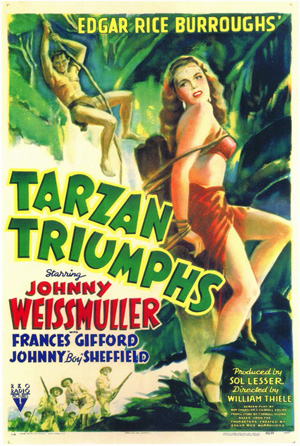
Tarzan Triumphs (1943)

So I just recently watched my first ever Johnny Wiesmuller Tarzan movie.  'Tarzan Triumphs' features a lot of firsts.  Not only is this the first Wiesmuller I watched, but it's the first in the series to feature the Nazis as villains, and the first in the series in which Jane is absent.

Although Jane is mentioned, she is replaced by a Jungle Princess named Zandra, who is played by Frances Gifford of 'Jungle Girl' fame.  Gifford is a big part of why I wanted to watch 'Tarzan Triumphs'.

Overall, this movie was much higher quality than I was expecting.  There's not a single gorilla costume in this picture.  Not that I have anything against people in gorilla costumes - quite the opposite in fact.  But 'Tarzan Triumphs' features trained monkeys, an elephant, crocodiles...

This clearly had a bit of a budget.  The quality makes it clear why the Johnny Wiesmuller series was so popular and long running.  And it's more than just the budget.  Although it does have a lot of the cheese you would expect a Tarzan movie to have - Tarzan speaking in one to three word sentences, the fact that Tarzan
and Jane named their adopted son 'Boy' and Jane was okay with this - the story is pretty well crafted.


The movie starts with Boy, who has wandered off into the jungle on his own contrary to Tarzan's instructions.  He finds a cliff overlooking the lost city of Palandrya.  Being the accident prone jungle boy that he is, Boy slips off the edge and needs to be rescued by Princess Zandra who happens to be passing through.  But the rock ledge they're standing on starts to give way, and they are both saved by Tarzan. 

 After this casual chance meeting that will drive the entire rest of the movie, Tarzan and Boy return to their tree house.  Tarzan had been going into town to get a letter from Jane.  She writes of the Nazis in war torn Europe, establishing the historical context, and explain Jane's absence.  Two birds, one stone.  Cheeta the monkey steals some fruit from the other monkeys, but Tarzan makes him give it back.  This seemingly cutesy throwaway moment is also important later.  Pretty solid beginning that shows the writers know what they're doing.

A group of Nazis parachute into the jungle, planning to invade Zandra's lost jungle city so they enslave the natives and steal all of their natural resources.  However, one of the Nazis is separated from the others.  He's the one carrying the radio, which the Nazis need to communicate with Germany.  He lands in a crocodile infested lake near Tarzan's tree house.


Tarzan rescues the Nazi, who manages to convince Tarzan that he's a lost explorer.  Cheeta is fascinated by the radio, and steals a vital part of the transmitter.

Meanwhile, the natives welcome the Nazis with open arms.  The leader of the Nazi expedition had been to the lost city before, and managed to convince the natives that he was a friend.  This parallels the Nazi now living in Tarzan's camp.  Personally, I thing the story would be more compelling if the Nazi in Tarzan's camp turned out to be sympathetic because Tarzan saved his life, but that's not the case.

Turns out the natives were a little too trusting.  Zandra's father
and brother are murdered, and in true Edgar Rice Burroughs tradition, the leader of the Nazis wants to make Zandra his bride.  She manages to escape, but she is pursued.

Meanwhile, the Nazi in Tarzan's camp is pretty fed up with the way Cheeta keeps messing with the radio, and he chases after the monkey with his gun.  Boy isn't too happy about this, as Cheeta is his pet.  Long story short, the bad guy ends up falling off a nearby cliff.

Tarzan discovers Zandra's distress and saves her from the pursuing Nazis.  She tries to talk him into saving her people, but he wants nothing of war and the world of men.  Boy is convinced that if Zandra - and this bit is kind of weird and creepy - acts and dresses more like Jane, Tarzan would be willing to help.  This awkward part of the movie makes it look like A: Tarzan is cheating on Jane in her absence and B: Boy thinks his adoptive mother is easily replaceable.  Boy's scheme fails to work however, and Zandra decides to return to her own people.  Tarzan tries to stop her because he believes it's too dangerous.

While all this is going on, the Nazis are searching for their radio.  They find Tarzan's camp and the radio, but the part Cheeta stole is still missing.  They interrogate Boy, and decide to take him back to the lost city.  Tarzan chases after them, swinging through the trees.  They shoot at him and he falls.  The Nazis search for his body, but the monkeys from the beginning cover him with leaves.  Zandra finds him and nurses him back to health.  Boy being captured finally lights a fire under Tarzan, and he and Zandra go to the lost city to fight some Nazis.

I thought this was a really good story.  That said, far to much of the movie is devoted to the monkey Cheeta doing something cute and/or funny, while Tarzan and Boy point and laugh.  This reminds me a bit of the later 'Thin Man' movies, which contained a good bit of filler featuring Nick and Nora's dog Asta.  Also I was a little disappointed by Princess Zandra.  She only gets a few action scenes - particularly compared to her alter ego Nyoka.  Tarzan is pretty lousy as a heroic figure.  I know the heroic journey requires the protagonist to first reject the call to adventure, but aside from rescuing the Nazi paratrooper from the crocodiles and then saving Zandra from the Nazis, Tarzan doesn't start being heroic until the last 20 minutes.  I know extreme anti social tendencies and self imposed isolation are a part of what make this version of Tarzan tick, but he looks a bit like a jerk for not helping Zandra save her city from the Nazis faster.

I read somewhere that this was the most violent of all the Johnny Wiesmuller Tarzan movies.  I found this one part to be a little shocking: In the climax Boy picks up a gun and shoots one of the Nazis.  I know this movie was made during WWII, so the mindset was one of 'Everyone must do their part for the war effort,' but it's a little disturbing to see an 8 to 12 year old shoot somebody without showing any signs of remorse.  Granted, any jury would rule this as self defense, but it's still kind of jarring.  I guess you 'had to be there' living through the war for this storytelling decision to feel appropriate.

'Tarzan Triumphs' is a pretty solid jungle adventure movie.  I can see now why the classic Tarzan pictures are considered classics, and I could definitely see myself watching more.