Showing posts with label Lost World. Show all posts

Saturday, July 8, 2017

Sinbad and the Eye of the Tiger (1977)


'Sinbad and the Eye of the Tiger' is the final installment of Ray Harryhausen and Charles H. Shneer's Sinbad trilogy.  If they had made a fourth movie I bet the title would have been 'Sinbad and the Thrill of the Fight.'  'Eye of the Tiger' didn't do as well as the previous two installments, possibly because it features less impressive monster fights, but also because it had unexpected competition from a certain little indie space adventure called 'Star Wars' that was released the same year.

'Eye of the Tiger' is a fun movie with a story that holds together pretty well, but I doubt any fan of the series would call it their favorite installment.  It's great as an adventure movie...but as a Sinbad movie?  Not quite so much.  Only the first third feels like an Arabian Nights inspired story.  The other movies had monsters like the Cyclops, the two headed Roc, and a six armed Indian idol.  This time around Sinbad faces Bug People, a giant Walrus, and a Sabre Tooth Tiger.  The previous Sinbad movies had exotic locals evocative of the far east.  This time around they're searching for the mythic land of Hyperborea in the Arctic.  And while there is an evil Sorceress, there's a much bigger emphasis on science and alchemy then there is on magic.

The movie starts with a coronation.  Prince Kassim, brother of this incarnation of Sinbad's love interest Princess Farrah, is being crowned Caliph.  But the ceremony is interrupted when their evil stepmother Zenobia places a curse on the prince.  Turns out she's a Sorceress in her spare time - which should be obvious because she wears all black just like all evil Sorcerers do - and she wants her son Rafi to rein instead of the rightful heir.

We switch to Sinbad, who is coming in to port to see his Gal Pal, but is surprised to find that the city gates are locked and the kingdom is under curfew.  A 'friendly merchant' (actually Rafi in disguise) tells Sinbad that the city is under quarantine and offers to let him stay in his camp until the gates open.  He serves Sinbad and his men poisoned wine, but Sinbad realizes that it's a trap.  Zenobia shows up and summons three Bug People to finish Sinbad off.  Okay, apparently they are supposed to be Ghouls, which ARE from Arabian mythology, but the movie never comes out and says that, and I think they look like Bug People. 

So Sinbad escapes from the Bug People, and meets up with Princess Farrah who sneaked out of the city to see him.  She warns him of Zenobia's treachery.  Her spell transformed Prince Kassim into a Baboon, and if they don't reverse the transformation within a certain amount of time he: A). Can't be crowned Caliph, and: B). Will be stuck in a Baboon body forever.  So our heroes seek out the fabled Greek alchemist Melanthius to see if his powers can reverse the transformation.  One think I feel this movie actually does better than the other two Sinbad movies is the romantic relationship between Sinbad and Farrah.  For one thing Farrah is a more rounded character.  There's more to her than 'Being in love with Sinbad'.  Between her concerns for her brother and her relationship Zenobia she has a lot of emotional stake in this movie.


Zenobia catches wind of Sinbad's Voyage and she and her son build a clockwork Minotaur than they dub 'the Minoton' to help stop our heroes.  As far as Monsters go, the Minoton really should have a talk with his agent.  He has a brief encounter with the palace guards, but for the rest of the movie he's a glorified galley slave who spends most of his time rowing Zenobia's boat.  He's a walking wasted opportunity for a good monster fight.


So after sailing through a thick fog, our heroes land on the island where they hope to find Melanthius.  I recently heard that this film actually had the highest budget of all of the Sinbad movies, which surprises me, because in these scenes it's painfully obvious that our heroes are superimposed over the background.  The other movies look like they're filmed on location, but this one uses very blatant greenscreen effects that haven't aged well at all.  After a brief attack from the island locals, our band of heroes are met by Dione, who is the daughter of Melanthius.  Here's a bit of trivia I found interesting: Dione, played by a Taryn Power, is apparently the real life daughter of actor Tyrone Power who stared in a bunch of Swashbuckler and Pirate movies in the 1940s.

Melanthius is stumped as to how to reverse Prince Kassim's transformation, but agrees to try and help.  Dione takes sympathy on and Kassim, and the two form a bond.  Meanwhile Zenobia and Rafi are delayed as their ship is damaged when they try to trace Sinbad's footsteps through the fog.  Melanthius reveals some sort of Alchemy Mumbo Jumbo about how an ancient civilization in Hyperborea harnessed the power four elements and the Aurora Borealis, and that by going to an ancient Shrine of the Arimaspi they can cure Kassim.

So they set sail for Hyperborea.  Zenobia uses her powers to transform herself into a seagull, sneaks aboard Sinbad's ship, and changes back into a six inch version of herself so she can spy.  She's detected and captured by Kassim, and Melanthius puts her in a glass jar for questioning.  He deduces that she uses a vial of fluid that she keeps around her neck to transform.  Thinking he can use this fluid to cure Kassim, he tries it out on bee.  The bee grows to the size of a large watermelon, and starts chasing Melanthius around the cabin.  In the chaos Melanthius knocks over the jar holding Zenobia prisoner.  She transforms back into a seagull and escapes, but not before taking a peak at the map leading to Hyperborea.  Unfortunately, she doesn't have quite enough fluid to change 100% back into her human form.  Zenobia will be spending most of the rest of our story with one webbed foot.

So our heroes reach this ice tunnel that will take them right to Hyperborea, but their ship is too big to take the shortcut.  So they build a sledge and continue their journey over the ice flows.  And it's here that they meet up with that aforementioned Walrus, and we get our second real monster fight of the movie (The giant bee doesn't count in my opinion).  Sigh.  Like I said, the Minoton really needs to have a talk with his agent.

Meanwhile Zenobia and Rafi find the tunnel, and their ship is just the exact right size to go through, because life isn't fair sometimes.  So, our villain's get to take the shortcut to the shrine.  While that's going on, our heroes reach the semi-tropical interior of Hyperborea.  They run afoul of a giant caveman type creature, but it turns out that he's just as afraid of them as they are of him.  Because, we apparently REALLY DON'T GET TO HAVE MONSTER FIGHTS IN THIS MOVIE.  They communicate with the creature, whom they name 'Trog' - short for the Troglodyte - using pictograph line drawing in the sand, and he leads them to the Shrine of the Arimaspi. 

But Zenobia found the shrine first, she uses the Minoton to force the entrance open.  He's crushed by a rock in the process, and Zenobia heartlessly states that he's 'Served his purpose'.  WHAT?  NO HE HASN'T!!! MINOTON!  FIRE!  THAT!  AGENT!  NOW!!!  Anyway, forcing the entrance harmed the structural integrity of the shrine, and when the heroes enter it begins to collapse around their ears with giant ice-cycles falling from the ceiling.  They notice a Sabre-Tooth Tiger encased in ice at the foot of the shrine, and Melanthius comments that it must be a guardian of the temple. 

Some people speculate that the entire climax of 'Eye of the Tiger' is a tribute to the 1935 film adaption of H. Rider Haggard's 'She'.  'She' also features a lost city at the north pole and a Sabre-Toothed Tiger trapped in the ice.  Ray Harryhausen was an avid fan of 'She', and he one of his final projects was the restoration and digital coloration of the classic adventure film. 


Our heroes are attacked by Rafi, but he's bitten by Kassim and breaks his neck falling done the stairs.  Sinbad and Melanthius rush to restore Kassim to his true form while Zenobia morns the death of her son.  She uses one last spell to enact her revenge.  Transferring her consciousness into the body of the Sabre-Tooth Tiger, she breaks free of the ice just as Kassim is restored to his human self.  Fortunately Trog returns to fight the beast.  We FINALLY.  GET.  A.  REAL.  MONSTER.  FIGHT.  Trog is no match for Zenobia, but he sacrifices himself so the others can escape, and Sinbad is able to impale the Tiger using the Minoton's dropped spear.  The film ends with the actual coronation of Prince Kassim, who exchanges meaningful glances with Dione.

And that is 'Sinbad and the Eye of the Tiger'.  Is it as good as the other two installments?  Well, that's obviously a matter of opinion.  Personally I think it fails as an Arabian Nights style Sinbad adventure, but that doesn't make it a bad movie.  It's a solid globetrotting adventure story set inside the Arctic circle, which isn't something you see everyday.  If you're a fan of Pulp adventure stories and swashbucklers, give this a watch.  But if you just came for the monster fights, you may be disappointed.

-Geekboy.

Tuesday, June 13, 2017

The 7th Voyage of Sinbad (1958)


The first in Charles H. Schneer and Ray Harryhausen's Sinbad trilogy, 'The 7th Voyage of Sinbad' is filled with '50s charm.  That is to say, it's slightly cheesier than the later installments.  We've got a sense of innocence and wonder, but we also have stilted line delivery and a child actor.  The story is less of a globe trotting 'Raiders of the Lost Ark' style adventure like 'Golden Voyage of Sinbad' and more like a fairy tale with sort of a Classic Disney feel.

'The 7th Voyage of Sinbad' is often considered the preferred classic of the trilogy.  Cheesy as it may be in spots, it's hard to argue with the '50s charm.  They call it '50s charm' for a reason I suppose.  It's charming.  And of all the movies in the trilogy, this one pulls the most inspiration from the 'Arabian Nights' source material.  It's a beautifully simplistic story that holds together well.  I think that's why it's many people's favorite, and how it manages to hold up in spite of itself.

The story starts with Sinbad and his beloved Princess Parisa on the return voyage to Baghdad.  They've been blown off course so they stop at the mysterious Island of Colossa to take on fresh water and supplies.  While there Sinbad and his crew run afoul of the monstrous Cyclops, who is chasing a mysterious man in black.  The mystery man, whom we'll come to know as the magician Sokurah, uses his magic lamp to summon a genie (that fore mentioned child actor) who helps ward off the Cyclops so Sinbad and his men can escape.  But in the escape Sokurah drops the lamp overboard, and it is recovered by the Cyclops.  Sokurah offers Sinbad a fortune to return for the lamp, but Sinbad drops a ton of exposition stating that if he doesn't return Parisa safely to Baghdad for their arranged marriage, her father will declare war on his people.

So they return to Baghdad, and Sokurah does his best to hire a crew to take him back to Colossa.  After the Caliph refuses to give him a ship Sokurah curses the Princess, causing her to shrink.  Her father is none too happy about this, and the threat of war looms large.  Sinbad isn't too keen on the prospect of marrying Thumbelina, so he goes to Sokurah begging him to lift the curse.  "Sure," says Sokurah.  "I have everything I need to break the curse in my laboratory back on that Island!"  Sinbad doesn't seem to suspect that Sokurah is the one who cursed Parisa in the first place.  Sinbad is a little slow sometimes.

Other than Sinbad's first mate, most of his crew aren't in a hurry to return to Colossa.  So Sinbad hires a crew of cutthroats and murderers, offering them full pardons from the Caliph if they sail with him.  Because Sinbad is a little slow sometimes.  Naturally the crew mutinies after two minutes, and Sinbad, Sokurah, and the First Mate are all locked in the brig.  But Sokurah knows they are about to sail through haunted waters and advises our heroes to stuff cotton in their ears, as the siren calls drive men mad.  The mutineers don't stuff cotton in their ears, and when they discover Sinbad and his men are unaffected, they let them out so they can steer around the rocks.

So, they eventually arrive on Colossa, and split in three groups.  Because splitting up is always a good idea.  The first group stays on the shore to man a giant crossbow in the event of future Cyclops attacks, and Sinbad and Sokurah lead the other two groups.  They need to find a Roc eggshell to complete Sokurah's curse breaking potion.  Sinbad's group stumbles across a cave filled with treasures.  Sinbad tries to convince the ex-cons that his girlfriend is more important than stopping to fill their pockets, and that works out as well as you might expect.  But it turns out that the treasure trove is actually the secret stash of the Cyclops, who likes shiny thinks.  Sinbad and his men are captured and put in a gigantic cage, and the Cyclops ties the First Mate to a pole to roast over a fire.

Sokurah hears the commotion and decides to investigate.  But it turns out he's less interested in saving the crew as he is in raiding the treasure cave in search of the magic lamp.  Sinbad gets the idea to use Parisa's size to their advantage.  She can slip through the bars and open the latch!  They manage to escape and rescue the First Mate  About this time the rest of the second group shows up and they all fight the Cyclops.  Most of the crew are killed, but Sinbad is able to put out the Cyclops's eye with a torch and lure it off the edge of the cliff.

Sokurah has found the lamp, but Sinbad learns that it was all he was after the whole time and takes it from him to use as leverage.  They continue up the nesting cliffs to find a Roc's nest.  They find an unhatched egg, and the crew are tired and hungry and their feet hurt, so they suggest just using that egg.  Sokurah advises them that it's safer to use one that has already hatched.  The crew refuse to listen, and crack open the egg so they can eat the baby Roc inside.  They are attacked by the baby creature, but manage to overcome it.

Sinbad continues to mistrust Sokurah, but Sokurah's the only one who knows how to summon the Genie.  Parisa decides to go inside the Genie bottle and talk to the genie.  She and the Genie become friends.  Turns out he wants to be a 'Real Boy' Pinocchio style.  So she offers to free him in exchange for his help, and he teaches her a cutesy little Genie summoning rhyme.  Basically it's the Green Lantern pledge, but for Genies.

About this time they are attacked by an adult Roc - presumably the mamma of the one they just killed.  Sinbad tries to use the Genie bottle, but it falls from his grasp.  Sokurah and the First Mate fight for possession of the magic lamp.  The First Mate tosses it to Sinbad just before Sokurah kills him.  Sinbad is knocked unconscious, and carried off by the Roc to it's nest.  Sokurah kidnaps Parisa to use as a bargaining chip later, and scurries off to his evil lair.

Sinbad escapes from the Roc's nest and uses the Genie to guide him to Sokurah's underground castle.  He has to sneak past a the dragon Sokorah keeps chained up at the entrance to keep the Cyclops out.  He catches up to Sokurah who offers to trade Parisa for the lamp.  He returns her to her normal size, but Sinbad, who learned a thing or two after all the double crosses he's been through in this movie, tells Sokurah he'll only get the lamp when they're safely back at the ship.  So Sokurah summons a Skeletal warrior to kill Sinbad, and we get a preview of what would become Ray Harryhausen's most iconic scene - the Skeletal battle from 1963's Jason and the Argonauts.  Sinbad and Parisa escape from Sokura's lair, and they fulfill their promise to free the Genie. 


Unfortunately they run into a second Cyclops on the shore.  Sinbad cuts Sokurah's Dragon free and the two monsters do battle as Sinbad and Parisa make a break for the ship.  (This kicks off that tradition of each of these movies ending with two monsters fighting.  It works much better in this one than the Centaur/Griffon battle in 'Golden Voyage of Sinbad.')  The Dragon overcomes the Cyclops, and Sokurah sics it on our heroes.  But Sinbad's crew still have an ace up their sleeves in the form of that giant crossbow.  They slay the Dragon, who crushes Sokurah as it falls.

Poetic justice served, they sail off for Baghdad.  Now the the Genie is a real boy he's decided to join Sinbad's crew, and he just so happened to load the Cyclops treasure in the hold by magic.  Give 'The 7th Voyage of Sinbad' a watch.  It's a classic, and if you're a Harryhausen fan, it's his first fantasy film, so you'll see how it shaped and influenced the rest of his career.

-Geekboy.

Thursday, May 11, 2017

Kong: Skull Island (2017)


I just saw 'Kong: Skull Island' last night and  HAD.  A.  TOTAL.  BLAST.  As someone who was a little disappointed in both 'The Jungle Book' and 'The Legend of Tarzan' last year, I really think this is the best jungle adventure movie we've had in ages.

As you probably know, 'Kong: Skull Island' takes place in the same world as 2014's 'Godzilla' and is setting up a loose remake of the 1962 Japanese film 'King Kong vs. Godzilla'.  I for one was a little concerned when I heard that this movie would be taking place in the 1970s - I saw this as a potential tribute to the 1976 King Kong, a version that I have both seen and hated.  I was pleasantly surprised though, the Vietnam War era setting really worked well, and even though the jukebox soundtrack was constantly reminding you of how 70's everything was it really captured the feel of a classic adventure story juxtaposed with a war movie.  Also, casual references to 'That nuclear incident in 1954' cough, Godzilla, cough, show that bumping the story forward a couple of decades was necessary for the crossover to work.  Also, changing the setting to the south pacific was a stoke of genius, tying Skull Island to World War II, Vietnam, and in a geographically similar location to Japan (And y'know, Godzilla).

All that crossover stuff is nice, but if you're like me, you didn't come for Godzilla references.  YOU CAME TO SEE KING KONG!  And as this is the third King Kong remake it's nice to see that they shook up the formula a little bit.  Don't get me wrong, I adore Peter Jackson's 2005 King Kong, but we really don't need another straight up remake of the original movie.  Gone is the empire state building and any reference to that fictional Arabian proverb about beauty and the beast.  We have many of the familiar elements, but they put them in a different order this time around.  The traditional King Kong ending - Kong swatting aircraft out of the sky - takes place close to the beginning this time around.  The climax is basically the Kong vs. T-rex fight, but this time around the T-rex is replaced with a new giant creature, a 'Skull Crawler'.

Spoiler warning.  If you haven't seen the movie but want to, proceed at your own risk.

The film starts during WWII with an American and a Japanese fighter pilot both crash landing on Skull Island.  As they are both on opposite sides of the same war their first inclination is to try and kill each other.  But as this IS Skull Island, they soon discover that they have much bigger problems than their personal allegiances.  As in, Kong Kong sized problems.  To this movie's credit, they don't monkey around - Sorry, couldn't resist - when it comes to showing us the monster.  One if the biggest fan complaints about the 2014 'Godzilla' is how little Godzilla actually appears onscreen.  Here we get our first look at Kong within the first 5 minutes, and I was on-board from that moment onward.

Fast forward to 1973.  We're introduced to professional monster hunter and government agent Bill Randa.  He's putting together a ragtag expedition to explore a Bermuda Triangle type skull shaped island.  Like any good expedition leader he's cryptic about his true motivations and how much danger is waiting for them on the island.  Other members of the expedition include hesitant tracker James Conrad - who is sort of your traditional 'great white hunter' stereotype - Mason Weaver, a photojournalist, which is the only pretty much the only available occupation for attractive heroines in classic adventure stories, and Colonel Preston Packard, who is here to handle the heavy artillery and order everyone around.

As well as playing the character types of classic adventure stories straight, they play dated and scientifically questionable elements of speculative fiction completely straight.  We've got an island surrounded by perpetual fog, hollow earth theory, giant spiders, and the movie is taking itself seriously the whole time.  Sure, the characters crack the occasional joke, but in general they take the lost world genre, update the time period, and do it without disrespecting the genre or losing credibility.  It's really refreshing, particularly after 'Legend of Tarzan' which didn't seem to understand that jungle adventure stories are supposed to be exciting and fun, rather than dull and soul draining.

It isn't long after arriving an skull island that the team runs afoul of Kong, and they've inadvertently (or perhaps not so inadvertently?) provoked him.  The survivors of this encounter are scattered.  Colonel Packard is seeing red after the loss of so many of his men, and his group sets out to find a way to take out Kong, while James Conrad, Mason Weaver, and company set out for the rendezvous point.  Conrad's team meet up with a group of natives and the long missing WWII pilot Hank Marlowe.

The natives have of course build huge wall around their village, but it turns out the wall is to keep out something EVEN WORSE than Kong - the Skull Crawlers.  Unlike the original King Kong, this wall is covered in spikes that are caked with the blood of past Skull Crawler attacks.  Marlowe warns the team against trying to taking out Kong, as he keeps the Skull Crawlers in check.  He also warns them against traveling at night, or taking that shortcut through the giant monster graveyard.  Our heroes primarily ignore all of Marlowe's warnings.  Poor Marlowe.

Our heroes eventually converge, but Packard is unwilling to continue to the rendezvous point.  Like Captain Ahab, Packard has become obsessed with a white whale.  A really hairy white whale that walks on two legs and is actually a gorilla.  Under the pretense of 'looking for survivors' Packard talks everyone to going back towards the helicopter where all the heavy artillery is kept.  On the way they have to cross that aforementioned monster graveyard, which just so happens to be where the Skull Crawlers hang out.  And here's where our heroes - particularly Mason and Conrad - get their chance to shine.


Side note: One problem I have with Mason, unlike Ann Darrow in previous versions, is that she isn't given much to do.  She doesn't have a big role in humanizing Kong - They only have about three scenes together - She'll occasionally wander off to take pictures, and you think she's about to be attacked by a big monster, but nothing happens.  She only appears to be in the story because it's traditional for a King Kong movie to have a pretty blonde girl who gets menaced by big monsters, but this movie did away with any of that 'Beauty and the Beast' damsel in distress stuff.  She does play a big part in some of the action scenes though, taking out Skull Crawlers with cigarette lighters and flare guns.  I love how resourceful she is in a fight.

Speaking of the monster fights - another thing that didn't totally work for me was the way they kept cutting away from our main characters to show Kong fighting a big monster.  The first example of this, we have a lone soldier separated from the others.  He stops by the river to wash his wounds.  Then Kong shows up and starts washing HIS wounds from that helicopter fight in the beginning.  It's a cool scene.  But then this big octopus shows up and they start fighting.  What?  Why is this scene in the movie?  It's random and kind of distracting.  The other place is where Marlowe is telling the team about how Kong protects the natives from the Skull Crawlers and we cut to Kong fighting Skull Crawlers.  I get the purpose for this bit, but it seems like an odd transition or something.


Anyway, back to the story.  Once our heroes find out Packard's plan to kill Kong, they are divided - our heroes are heeding Marlowe's warnings, and the soldiers are torn between following orders and doing the right thing.  Unfortunately Packard's attack both weakens Kong and awakens the biggest and baddest of all the Skull Crawlers.  Our heroes hotfoot it back to the river, but they're pursued by the Skull Crawler.  One of the soldier's bravely stays behind to take out the Skull Crawler, a live grenade in each hand.  Unfortunately his sacrifice is wasted as the beast knocks him out of the way with it's whip-like tale.  I had a bit of a debate with my sister about the scene.  She was a bit annoyed at this character's death, saying it felt pointless.  I countered with the argument that it highlighted that character's bravery, made the Skull Crawler seem that much more powerful, and made you more emotionally invested in the climax.  If not for the heroic sacrifice the ending would've just been two monsters punching each other.  And boy do those two monsters fight each other.  I had the biggest grin on my face when Kong grabs an anchor chain from a derelict ship and starts swinging it around like a mace.

And that's Kong: Skull Island.  It respects it's pulp adventure roots, but it's not afraid to shake up the formula and bring new things to the table.  Definitely worth a watch.

- Geekboy.

Monday, August 22, 2016

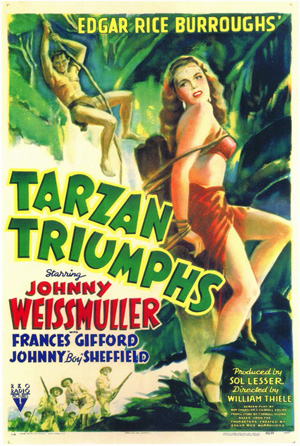
Tarzan Triumphs (1943)

So I just recently watched my first ever Johnny Wiesmuller Tarzan movie.  'Tarzan Triumphs' features a lot of firsts.  Not only is this the first Wiesmuller I watched, but it's the first in the series to feature the Nazis as villains, and the first in the series in which Jane is absent.

Although Jane is mentioned, she is replaced by a Jungle Princess named Zandra, who is played by Frances Gifford of 'Jungle Girl' fame.  Gifford is a big part of why I wanted to watch 'Tarzan Triumphs'.

Overall, this movie was much higher quality than I was expecting.  There's not a single gorilla costume in this picture.  Not that I have anything against people in gorilla costumes - quite the opposite in fact.  But 'Tarzan Triumphs' features trained monkeys, an elephant, crocodiles...

This clearly had a bit of a budget.  The quality makes it clear why the Johnny Wiesmuller series was so popular and long running.  And it's more than just the budget.  Although it does have a lot of the cheese you would expect a Tarzan movie to have - Tarzan speaking in one to three word sentences, the fact that Tarzan
and Jane named their adopted son 'Boy' and Jane was okay with this - the story is pretty well crafted.


The movie starts with Boy, who has wandered off into the jungle on his own contrary to Tarzan's instructions.  He finds a cliff overlooking the lost city of Palandrya.  Being the accident prone jungle boy that he is, Boy slips off the edge and needs to be rescued by Princess Zandra who happens to be passing through.  But the rock ledge they're standing on starts to give way, and they are both saved by Tarzan. 

 After this casual chance meeting that will drive the entire rest of the movie, Tarzan and Boy return to their tree house.  Tarzan had been going into town to get a letter from Jane.  She writes of the Nazis in war torn Europe, establishing the historical context, and explain Jane's absence.  Two birds, one stone.  Cheeta the monkey steals some fruit from the other monkeys, but Tarzan makes him give it back.  This seemingly cutesy throwaway moment is also important later.  Pretty solid beginning that shows the writers know what they're doing.

A group of Nazis parachute into the jungle, planning to invade Zandra's lost jungle city so they enslave the natives and steal all of their natural resources.  However, one of the Nazis is separated from the others.  He's the one carrying the radio, which the Nazis need to communicate with Germany.  He lands in a crocodile infested lake near Tarzan's tree house.


Tarzan rescues the Nazi, who manages to convince Tarzan that he's a lost explorer.  Cheeta is fascinated by the radio, and steals a vital part of the transmitter.

Meanwhile, the natives welcome the Nazis with open arms.  The leader of the Nazi expedition had been to the lost city before, and managed to convince the natives that he was a friend.  This parallels the Nazi now living in Tarzan's camp.  Personally, I thing the story would be more compelling if the Nazi in Tarzan's camp turned out to be sympathetic because Tarzan saved his life, but that's not the case.

Turns out the natives were a little too trusting.  Zandra's father
and brother are murdered, and in true Edgar Rice Burroughs tradition, the leader of the Nazis wants to make Zandra his bride.  She manages to escape, but she is pursued.

Meanwhile, the Nazi in Tarzan's camp is pretty fed up with the way Cheeta keeps messing with the radio, and he chases after the monkey with his gun.  Boy isn't too happy about this, as Cheeta is his pet.  Long story short, the bad guy ends up falling off a nearby cliff.

Tarzan discovers Zandra's distress and saves her from the pursuing Nazis.  She tries to talk him into saving her people, but he wants nothing of war and the world of men.  Boy is convinced that if Zandra - and this bit is kind of weird and creepy - acts and dresses more like Jane, Tarzan would be willing to help.  This awkward part of the movie makes it look like A: Tarzan is cheating on Jane in her absence and B: Boy thinks his adoptive mother is easily replaceable.  Boy's scheme fails to work however, and Zandra decides to return to her own people.  Tarzan tries to stop her because he believes it's too dangerous.

While all this is going on, the Nazis are searching for their radio.  They find Tarzan's camp and the radio, but the part Cheeta stole is still missing.  They interrogate Boy, and decide to take him back to the lost city.  Tarzan chases after them, swinging through the trees.  They shoot at him and he falls.  The Nazis search for his body, but the monkeys from the beginning cover him with leaves.  Zandra finds him and nurses him back to health.  Boy being captured finally lights a fire under Tarzan, and he and Zandra go to the lost city to fight some Nazis.

I thought this was a really good story.  That said, far to much of the movie is devoted to the monkey Cheeta doing something cute and/or funny, while Tarzan and Boy point and laugh.  This reminds me a bit of the later 'Thin Man' movies, which contained a good bit of filler featuring Nick and Nora's dog Asta.  Also I was a little disappointed by Princess Zandra.  She only gets a few action scenes - particularly compared to her alter ego Nyoka.  Tarzan is pretty lousy as a heroic figure.  I know the heroic journey requires the protagonist to first reject the call to adventure, but aside from rescuing the Nazi paratrooper from the crocodiles and then saving Zandra from the Nazis, Tarzan doesn't start being heroic until the last 20 minutes.  I know extreme anti social tendencies and self imposed isolation are a part of what make this version of Tarzan tick, but he looks a bit like a jerk for not helping Zandra save her city from the Nazis faster.

I read somewhere that this was the most violent of all the Johnny Wiesmuller Tarzan movies.  I found this one part to be a little shocking: In the climax Boy picks up a gun and shoots one of the Nazis.  I know this movie was made during WWII, so the mindset was one of 'Everyone must do their part for the war effort,' but it's a little disturbing to see an 8 to 12 year old shoot somebody without showing any signs of remorse.  Granted, any jury would rule this as self defense, but it's still kind of jarring.  I guess you 'had to be there' living through the war for this storytelling decision to feel appropriate.

'Tarzan Triumphs' is a pretty solid jungle adventure movie.  I can see now why the classic Tarzan pictures are considered classics, and I could definitely see myself watching more.

Monday, July 25, 2016

The Mole People (1956)


When I started this blog my intention was to review lots and lots of monster movies of the 40s and 50s. how many have I actually reviewed so far?  Not enough to consider this a monster blog, that's for sure.

So I just recently gave this 1956 sci fi adventure movie a re-watch.  I'd previously seen it maybe 6 years ago.  It actually held up much better than I was expecting.  As a teenager who was just starting to watch B-movies I didn't realize that there was a difference between a GOOD monster movie and a REALLY REALLY BAD ONE.  And this may not be a great monster flick like 'Creature from the Black Lagoon' but it's certainly a few notches above 'Plan 9 from Outer Space' or 'Robot Monster'.

So the movie actually starts in a library with a scientist explaining Hollow Earth theories to the audience.  This doesn't really have anything to do with the story.  It's just that the movie is begging you to take it seriously.  Cut to an archeological expedition digging in the foothills of the Himalayan mountain range.  They're searching for a mythical lost city.  They keep name-dropping the Epic of Gilgamesh and the Biblical Flood to further establish credibility.  Unfortunately an earthquake disturbs the dig site.  It also dislodges an oil lamp from one of the mountain peaks.  The lamp is brought to the archeologists by a young shepherd boy.

The scientists study pictographs etched into the lamp.  It tells of the Gilgamesh version of the flood and a temple built high in the mountains.  Thinking this may just be the lost city they're looking for, the explorers set off to find the temple.

To further establish credibility the filmmakers show that they actually researched mountaineering.  The explorers explain that they plan to set up multiple base camps on the side of the mountain.  They show our heroes crossing portable aluminum bridges, close-up shots of their crampon clad feet, and of course, native Sherpas carrying their gear (I don't know if you can tell, but I was a bit of a mountaineering geek in my teenage years).   I don't usually expect to see this much accuracy from a B-movie.

So they reach the top of the mountain and find the lost Sumerian temple.  Unfortunately the ground crumbles under their feet and one of the members of the expedition falls into a seemingly bottomless chasm.  Dr. Bentley - the leader of the expedition - establishes himself as the hero of the story when he immediately leads the way down the chasm after his comrade.  Unfortunately a cave-in traps three members of the expedition - Dr. Bentley, Dr. Bellamin, and Dr. Lafarge - underground.  They set off exploring the tunnels and trying to find another way out.  They discover some of the tunnels are man-made.  After stopping to rest they are attacked by the titular Mole People.

The Mole People are really cool.  Nicely designed monster costumes.  They claw their way up through loose dirt, and then grab you and pull you under.  My only complaint is the way they have that hump on their backs, but they walk upright.  Shouldn't they stoop over?

So our heroes are captured by the mole men but manage to escape.  They find their way to an underground city populated by Albinos.  Dr. Bentley theorizes that this is the rest of the lost Sumerian city buried underground centuries ago in one of the mountains many earthquakes.  The Albinos aren't to keen on new arrivals.  The natives have a strict population control policy due to the limited quantity of their mushroom food source.  So they decide to sacrifice our heroes to the 'Fires of Ishtar'.  Our heroes aren't to keen on the prospect of being scarified, so they put up a fight.  They use a handy dandy flashlight to blind the Albinos and make a break for it.  Unfortunately they get separated in the tunnels and Lafarge is killed by the Mole People.

Our heroes bury their fallen comrade, and head back to the city.  They manage to convince the natives that they're 'messengers from the gods' because of their magic flashlight.  They get a lot out of this deal.  Not killed for one.  Also they get their own slave girl as an added perk.  The slave girl - named Adad - is a genetic throwback who is treated like dirt by the natives because she isn't an Albino.  She's your typical empty headed native love interest from this type of movie.
Dr. Bentley: "You shouldn't have to be a slave.  You should be free."
Adad: "What is free?"
Later in the movie:
Adad: 'What is love?"
I'm kind of surprised she never asks what breathing is.

It's revealed that the Mole People are mindless slaves of the Albinos.  They are forced to work in the mines and harvest Mushrooms.  Our heroes - being the square-jawed heroes that they are - oppose injustice of any kind, including this inhumane treatment of Mole People.  They more or less try to run the underground city using the power of the magic flashlight.

The main villain of the story is the high priest who wants this magic flashlight for himself.  He has been suspecting the divine status of our heroes for some time now, and the discovery of Dr. Lafarge's body confirms his theory.  Fun fact, the high priest is played by Alan Napier, probably best know as Alfred from the 60s Batman TV series.

He hatches a plan to feed our heroes drugged mushrooms and then sacrifice them to the Fires of Ishtar.  Previously to this point we've seen some native girls be sacrificed in part of an elaborate ceremony.  Masked priests open a massive set of doors and a blinding light streams out.  The sacrifices willingly enter the chamber and the doors are closed behind them.  Later masked Albinos carry blackened corpses from the chamber.

Adad actually does something useful at this point.  She gets help from the sympathetic Mole Men to stop Dr. Bentley and that-other-guy-she-doesn't-really-care-about from being sacrificed.

- If this is a movie you think sounds interesting, spoiler alert from this point on -

The high priest attempts to stop the Mole People revolution using the magic flashlight.  Unbeknownst to him, the batteries had previously gone dead.  Thanks to the enraged Mole People, the high priest also goes dead.  Adad tries to get the massive door open, but her puny little 50's girl arms can't do it, so the Mole People smash the door in, causing the Fires of Ishtar to stream into the room.  Adad, headless of the danger, rushes into the chamber to free Dr. Bentley and what-sis-name.

It is then revealed that the Fire of Ishtar is just sunlight.  It burns the skin of the Albinos, but is harmless to Adad and our heroes.

So they decide to climb out of the light well to the surface world.  And here comes the part that - in my opinion - prevents this from being a really good movie.  Something movies of this era liked to do is tack on a tragic ending for no reason.

When they reach the surface there's another earthquake.  Adad runs back towards the temple like the little idiot she is and is crushed by a collapsing pillar.  This feels so pointless and tacked on that it kind of ruins an otherwise good movie at the last minute.

BUT if you are into lost world type stories, adventure movies, or classic monsters, you should definitely check this one out.  True, it may take itself a little too seriously at first for as campy as the lost city actually is, but if you're already familiar with the clichés of the genre you should get a chuckle out of the power hungry high priest, the heroes pretending to be all powerful because they have access to 20th century technology, and the love story between the hero and the ditzy slave girl.

Monday, February 13, 2012

King Kong (Part 3)


Well, I finally tracked down the original 1933 King Kong to refresh my memory and finish up this series of reviews. (Guess that means I'll have to find something new to write about...)

I thought the movie held up quite well, especially when you consider the fact that it was made 78 years ago. The cinematography was beautiful, and the stop-motion effect were obviously groundbreaking. Although it wasn't the first time dinosaurs appeared on the big screen. The first time would be the silent movie The Lost World, made 8 years earlier. King Kong had much more interaction between humans and colossal creatures though.

Kong's first appearance was much more suspenseful then I remembered, with a silhouette of an unknown beast tearing through the jungle, masked by the trees, as a helpless Ann Darrow looks on in fear. (You've gotta give Ann some credit though, she had just about broken free of the ropes when Kong grabs her.) Face it, Steven Spielberg uses similar techniques when the dinosaurs first appear in Jurassic Park.

The film's dialog is just a little stiff in parts, particularly some of the mushy stuff between Ann Darrow and Jack Driscoll, and I'm pretty sure I heard the natives chanting "Costco" at one point.

King Kong himself reminded me of The Incredible Hulk, only he isn't green and doesn't have a catchphrase like "Hulk SMASH!" But that makes sense, since Hulk is already a sort of mix up of Dr. Jekyll/Mr. Hyde and Frankenstein's Monster.

Well, Those are my thoughts.
---Geekboy.

Thursday, January 5, 2012

King Kong (Part 1)


The original 1933 King Kong was my introduction to the world of monster movies. Unfortunately, that was so long ago I don't remember it real well. Also, I was so young and naive I didn't appreciate the time period, the style, and the achromatic (That's a big fancy art word for 'Black and White') film. I had difficulty following the plot (Big gorilla chases Fay Wray, what's to get?) and telling the characters apart.

Fast-forward to 2012. I'm now a big fan of older movies, and I've just seen the 2005 King Kong for the first time. (Yeah, I know, you're asking yourself where've I been for the last 6 years, right?)
So: Here's the plan. I'm going to compare and contrast the movie I've just seen, to a classic that I hardly remember.

Firstly: I really appreciate the fact that Peter Jackson set the 2005 movie in the depression era. I don't think that this pulpy story would work well in the present day. This also shows proper respect to the original story.

Jackson draws a nice parallel with the scene were Kong fights the Pterodactyls... (Wait...What? Oh, sorry.) ...I mean Giant Bats... with the climax of Kong fighting the bi-wings atop the empire state building. I also liked how after Ann Darrow is sacrificed in the beginning, she is willing to sacrifice herself to stop Kong's rampage. That's a strong dynamic I didn't feel was in the original.

I'd have to see the original again to give my thoughts on Fay Wray's Ann Darrow. Famed for nothing more that a scream queen, I've seen a few of her other movies recently (The Most Dangerous Game, The Vampire Bat, and Mystery of the Wax Museum) and discovered that she wasn't a half bad actress.

One thing that bothered me in the 1933 movie, was the fact that 20 zillion redshirts die trying to save one woman. I know now that this is just typical of this kind of story.

Since everyone knows how the story ends, Jackson went for drama, trying to stretch out the iconic finale as long as possible. Personally, I thought it was a little melodramatic, but you can't really end the story any other way.

Well, That about wraps up MY irrelevant thoughts on the latest movie. I plan to also watch and review the 1976 King Kong in the near future.

Stay tuned.