So I just recently watched the first season of Netflix Daredevil. Yeah, I know what you're thinking. "Geekboy, as a comic nerd and Daredevil fan you should have seen it ages ago!" Some of us don't have Netflix accounts okay? Some of us are now waiting impatiently for season two to come to Amazon, okay? OKAY? Good.
As someone who doesn't hate the 2003 movie quite as much as everybody else, I thought it would be fun to do a little compare and contrast. What did the show do better than the movie? What elements of the movie still hold up?
I think when people look back at the movie they forget the time period it was made in. 2003. The same era as Sam Rami's Spiderman, (Which holds up pretty well) Brian Singer's X-men, (Holds up okay, X2 more so than X1 and X3) and those Fantastic Four movies (which really don't hold up well at all). In my opinion, Daredevil holds it's own with X-men, is better than Fantastic Four, but is not quite as good as Spiderman.
Then 2008 happened. DC/Warner Bros. The Dark Knight blew away critics and fan alike, and Marvel got their own studio and the complete creative control that comes with having your own studio. A few years down the road Disney and Marvel Studios would merge. Marvel received additional financial backing and a beefed up marketing campaign out of this deal. The budget, storytelling quality, and respect for the source material of superhero movies has been climbing ever since, and it's easy to forget that when you look back at the earlier superhero movies.

All that being said, Daredevil 2003 does have some problems. I think the main reason people hate this movie is that it's overcrowded and rushed. They tried to squeeze every iconic Daredevil thing into ONE MOVIE. So, we have Daredevil's origin, his fight to take down Kingpin, battling his nemesis Bullseye, and most of the Elektra saga in an hour and 40 minute runtime. (Please note that I'm talking about the Theatrical release. I haven't seen the Directors Cut, but I've heard it expands the Kingpin storyline, gives Nelson and Murdock more screen time, and overall vastly improves the story.)
Ideally it should have been a trilogy, with part one starting with Matt's origin and ending with the death of Elektra's father. Part two would pick up with Elektra joining The Hand for her Ninja training and then returning to Hell's Kitchen to take out Daredevil, and ending with her death and the hands of Bullseye, whom Daredevil would take out in the climax. The third movie would bring in Stick and The Hand, deal with Elektra's resurrection, and end with Daredevil going toe to toe with Kingpin (who has been pulling the strings this whole time). At this point we could have an Elektra spinoff in which Elektra and Stick battle what remains of the Hand.
So the biggest weakness of the movie is taken care of in the show. They can take their time to tell the story. My favorite thing about Daredevil 2015 is the way they focus on and develop the supporting cast. Foggy Nelson, Karen Page, and Ben Urich all get lots of screen time. And although the show is 'dark and gritty' Foggy and Ben bring a lot of humor. It's not humor like all of the Joss Whedon quips in 'The Avengers' though. It's a more realistic Film Noir style humor that feels like real people having a real conversation. It's a little cynical, but it's laugh out loud funny. The villains also get more development and backstory thanks to the format of a 13 episode miniseries.
That greatest strength of focusing on the supporting cast can also be a bit of a weakness though. It's called Daredevil, but there are places where Matt Murdock feels like a third wheel in a story about Karen, Foggy, and Ben as they fight to take down a sympathetic Wilson Fisk. Compare that with the movie, where Matt is NARRATING HIS OWN LIFE STORY.
So kick off this compare and contrast, let's take a look at each character in turn.
Foggy Nelson:

I honestly think the relationship between Foggy and Matt is a lot of fun in the 2003 movie. The continuing playful argument about Alligators in the sewers of New York, a clever nod to all those times Daredevil fought Sewer Alligators in the comics, that scene in the office where Foggy repeatedly misses the basketball hoop and Matt gets it on the first try, and that bit where he gives Matt mustard instead of honey for in his tea, and then Matt switches drinks with Foggy when he isn't looking. Foggy doesn't necessarily get all of the screen time that he deserves, but it's clear that Matt and Foggy have a fun and believable working relationship.

I enjoy Movie Foggy so much I was a little worried about the show, but Netflix Foggy KILLS IT. He's funny, has a believable relationship with Matt, he's willing to roll up his sleeves and do some grunt work - literally when they're helping out an elderly woman fix up her apartment - and has moments of bravery beating up thugs in a dark alley. Then there's that part where he's in hospital bed, and Karen has to make sure he stays there rather than hop out of bed to search for Matt when he's missing. Plus his relationship with Karen is super sweet.
This feels a little close to call. I love both versions of Foggy. But Netflix Foggy does have more time to shine, and they are able to show us more aspects of his character. But I really think this is the TV show format rather than quality of writing or actors portrayal.
Karen Page:

This one is no contest. In the movie Matt and Foggy do have a blonde secretary in one scene. She only has one or two lines of dialog, and I don't even remember if she's named as Karen. The movie was focusing on Daredevil and Elektra though, so it makes sense to pretty much skip Karen Page. As I can't really talk about Karen in the movie, I can't talk about Elektra much either -not until I see Season 2 at any rate.

But Karen in the show is worth talking about. She pretty much kicks off the story. As the first client for Nelson and Murdock, she's the one who pulls our heroes into the web of intrigue that is the organized crime of Hell's Kitchen. She also brings Ben Urich aboard. She's the glue that holds Nelson and Murdock together later on. I've read that the actress wanted to find a middle ground between the girl-next-door Karen Page of the Silver Age and the darker, post 'Daredevil: Born Again' Karen. The show does a really good job with this. Karen starts out as a good person in big trouble, and by the end of the season, after all the poking around in the hornet's nest that is Kingpin's crime organization, she's battling some inner demons. She's done things she regrets. She's carrying a lot of guilt for some of the consequences for her actions.
Ben Urich:

This one is tricky. On one hand, I feel like the Ben Urich of the movie does a better job of adapting Ben's relationship with Matt and with Daredevil. In the comics, Ben figures out Daredevil's secret identity and struggles with whether he should print it in the Baily Bugle. On the one hand, story of a life time. On the other, it would ruin Matt's crime fighting career. Ben decides Daredevil's secret is worth more than a Pulitzer prize, and he and Daredevil become allies similar to Batman and Commissioner Gordon. And the movie adapts this story. The show does not.

In the show Ben and Matt share very little screen time. The season is half over before they even appear together. BUT. But this Ben has so much more development than the movie's Ben. We're rooting for this guy from the beginning. He's introduced by fighting the insurance company that doesn't want to pay for his sick wife's medical care. He's frustrated by the paper he works for and the small stories he's forced to work on when bigger things are being swept under the rug. He's a crusader with so much to loose, but that doesn't mean he's going to stop fighting.
So. Point to the movie for Matt and Ben's relationship, but ultimately a point to the show because Netflix Ben is awesome.
Wilson Fisk (AKA: The Kingpin)

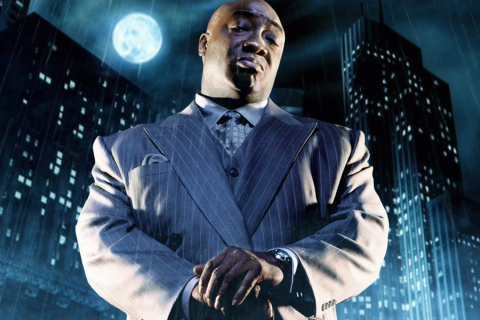
Personally I think movie Kingpin feels more like the Kingpin of the comics. Maybe the actor's size has something to do with that. He's huge. It's totally believable that he can hold his own against Daredevil in the climax. Also, he never looses his cool. The Kingpin of the comics is cold and calculating. He's a bit like a Bond Villain that way.

The Kingpin of the show is more fleshed out. He's more human. There's all this wonderful build up for the first three episodes where criminals are afraid to even whisper the name Wilson Fisk. So when we first meet Fisk, he comes across as a bit of a paradox because he seems like a slightly awkward nice guy. Until he snaps. Then he goes into something that's a cross between a berserk rage and a temper tantrum. He's the exact opposite of keeping his cool. I do think it's interesting that the only time Kingpin gets his hands dirty is when it's personal. If he thinks you're going to hurt some one he cares about, or harm his relationship with that person, he will kill you with his bare hands. I like how they included Fisk's relationship with Vanessa. In the comics, Vanessa was Kingpin's one weak spot. She managed to talk him into giving up a life of crime until she's kidnapped by a rival mob. The show puts it's own spin on the Fisk/Vanessa relationship.
This is another close one, but in my opinion the Kingpin of the movie is more accurate the comics, so point goes to the 2003 movie.
Okay, now for some more complex stuff. Daredevil himself. I feel like I need to break this into a couple of parts.
Origin Story:
The movie is a sort of frame story, beginning with a Daredevil who has been injured in his battle with Bullseye. One of Matt's first lines is in the form of voice-over: "They say that just before you die, your whole life flashes before your eyes. That's true...even for a blind man." Personally I think this is a really clever way to start. Some people think the voice-over narration is kind of cheesy, but as a fan of Film Noir era detective stories and 80's action shows like MacGyver, I see voice-over as a good narrative technique. And this bit of narrative prepares the audience for a flashback AND tells newcomers who may not be familiar with the character that he's blind from the get-go.
We're then told how Matt was blinded as a child, and his increased abilities, of his father - a boxer who is murdered when he refuses to throw a fight, ect. ect. Pretty faithful to the comics.
The show follows the same beats, but they drag it out over about four episodes, and they expand on everything. They go into greater detail of Matt's relationship with his father, making Battlin' Jack Murdock's death really tragic. They have an episode devoted to Matt's training with his mentor, Stick, and finally an episode devoted to his college days with Foggy and why he first put on the mask. This is where I have my first real beef with the show. In every other telling of Daredevil's origin story I've seen IT IS CLEAR THAT THE DEATH OF MATT'S FATHER IS WHY HE FIRST STARTED FIGHTING CRIME. That's not the case here. Matt is first seen taking out a sexual predator. I'm still scratching my head about this change. Was it to make Matt seem more selfless? Maybe.

But there's a bit of a disconnect between Battlin' Jack's death and the rest of the story if Matt's initial motivation isn't bringing his father's killer to justice. The only clue we have that this is part of Matt's motivation is that he keeps his costume in a secret compartment in the trunk that holds all of his father's boxing gear. This is a nice shout out to Daredevil's original yellow and red costume, which he made from his father's robe.
So the movie messes with this part of the Daredevil Mythos as well. It's revealed at the end that Kingpin used to work as a mob enforcer, and that he was the one who pulled the trigger and killed Jack Murdock. This was done to make the final battle personal and tie everything up in a neat bow, so I can see the reason for the change.
To be fair, I haven't watched season 2 yet, and I heard that 'The Fixer,' the man who had Battlin' Jack killed makes an appearance. So I can't really judge the show's origin fairly yet, BUT so far it's my opinion that the two origin stories are tied. The Netflix origin story may be fleshed out, but leaves out what I feel is a crucial detail.
Daredevil's Powers:
One interesting thing the show does is it really plays down the fact that Daredevil is a superhero. This makes sense for the feel the show-runners were going for. I recall producer Jeph Loeb stating in an interview that they wanted to make Daredevil a good crime drama first, and a superhero show second. And that's apparent in the way they depict DD's powers. We're only shown the world as Matt sees it once or twice. If you've ever read a silver age comic you probably noticed how Matt is always telling the audience things like: "I just love being blind. My other senses are better than seeing. I can tell you how many grains of salt are on a pretzel, just by licking it!" Who cares how many grains of salt are on a pretzel? WHAT KIND OF A SUPERPOWER IS THAT?
To contrast, Matt never brags about his powers in the show. For him, it's just a fact of life. At one point he informs Claire that she just reopened a nasty wound by moving around to much. "How do you know?" she asks. "I could taste copper in the air," he responds, in a 'can't everybody taste copper in the air?' sort of way. She like: "Copper, of course." in a rolling her eyes -I-think-you're-a-little-crazy- sort of way.
But since the movie is from Matt's point of view, we're shown how he sees the world on a regular basis. My favorite is the way he sees the world more clearly when it rains because the raindrops echo off all the surfaces they hit. This leads to a sweet moment with Elektra, a really sad moment at her father's funeral, and is foreshadowing for the climax.
So I don't think there's a clear winner or a loser here. Both do a great job of showing Daredevil's powers, it's just that the one does it in a more realistic and understated way.
Moral Values:
I've said before that Daredevil is pretty much my favorite superhero because of his dedication to fighting justice. The movie doesn't always do the best job of showing this. For example, that rooftop scene with Elektra in the rain I mentioned earlier: Matt hears someone being beaten in the alley below. Does he go to the rescue? Nope. He's too busy hanging out on rooftops with his new girlfriend! Fans have called this scene out for being out of character, and they're right. Matt Murdock would never do this.

But the show gives us a Matt Murdock who is on a slippery slope morally speaking. At the beginning of the show we really don't know where he stands and which lines he's willing to cross. We see him in a confessional seeking forgiveness "Not for what I've done father, but for what I'm about to do!" He almost starts as an antihero, on the path to becoming a real hero. Or not. We don't really know until the end. He also comes across as a
little hypocritical, calling out Foggy and Karen when they're sneaking
around like amateur detectives, saying they need to take out Fisk
through legal means. True, he's trying to keep them safe, but he's a
vigilante sneaking around at night trying to take Fisk down.
Hypocrite. Also, he had me really worried early on when he takes on a
client that he knows is guilty. Matt! No! You only defend the
innocent!
The show had me on the edge of my seat when it came to Matt's moral condition, and that's a good place to be. Point goes to the show!
I have one more point - and this one is kind of minor.
The Soundtrack:
Even people who hate the 2003 movie (AKA, most people) acknowledge that the soundtrack is awesome. Songs match the moods of scenes they're in. My favorites are the two tracks from Evanescence - 'My Immortal' during the funeral for Elektra's father, and then 'Bring me to Life' during her training montage.
But some of the soundtrack decisions really have me scratching my head. And I'm not just talking about how Tamer's 'Beautiful Crime,' the awesome song from the trailer is never featured in the show. (Disappointing---!) There are two places in the finale where the music doesn't work for me. One is in the beginning of the episode, a funeral, where this blues 70's thing is playing and killing the otherwise somber mood. I think a slow instrumental piano or cello piece would have been more fitting. The other place is where the FBI are rounding up mobsters in slow motion as opera music is blaring.
Not all of the music is this mismatched. I love the part and the end of the first episode where an instrumental rock piece builds in intensity as Matt trains in Fogwell's Gym, and we're shown glimpses of the criminal element he'll spend the rest of the season fighting. And the theme music is beautiful, with somber piano, strings and bells. But when the music doesn't quite work it's really jarring.
Point goes to the movie.
Bottom Line: I really like both. The movie is underrated and unfairly criticized in my opinion, but is not without flaws. The show absolutely lives up to the hype. Great storytelling and fully developed characters that feel like real people. With adaptions superhero origins that have been told and retold over and over again in comics there is definitely room for more than one interpretation on film.

 Granted, Batman's no kill policy in the comics is pretty much the only reason Joker is still alive. There are fans who think that it's inconsistent to have Joker - who has murdered one of the Robins in this continuity - running around Gotham and have Batman be ready and willing to take out Superman 'If there's even a 1% chance' that he's a threat. There's much more than a 1% chance that Joker is a threat.
 One of the best on-screen adaptions of the superhero no kill policy is the Netflix Daredevil series. And the reason it works is that the no kill policy is highlighted and shown to be a big deal. It's a major issue that Matt Murdock is wrestling with. It's a line that he comes dangerously close to crossing multiple times over the course of the first season. Because of this the last couple of episodes are really intense because you are aware that Matt is capable of killing and at this point you really really don't want him to. And this is the way it should be done. If you are going to bother with a no kill policy you should have something to say with it. Otherwise what's the point?